
- 8 new stores opened and 25 new franchise deals signed in 2025
- 32 stores in development with projections of some exceeding $1 million in first-year revenue
- Average Unit Volume (AUV) of $631,000, competitive but not record-breaking in the frozen dessert industry
Experts would likely conclude that 16 Handles' aggressive expansion strategy shows promising growth potential, but its long-term success hinges on overcoming financial weaknesses and maintaining franchisee satisfaction amid a competitive dessert market.
16 Handles' Sweet Expansion: Froyo Revival or Frothy Growth?
NEW YORK, NY – January 08, 2026 – By Sharon Henderson
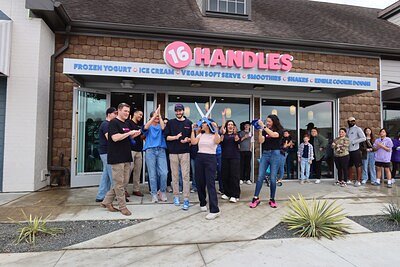
Frozen yogurt franchise 16 Handles capped off 2025 with a series of bold announcements, declaring a milestone year of growth that saw the brand open eight new stores and sign 25 new franchise deals. The company, which pioneered the self-serve frozen yogurt model in New York City back in 2008, is now touting a national expansion that it claims is fueled by a surge in demand, category-leading economics, and a pipeline of 32 stores in development. This aggressive growth narrative, featuring grand opening day sales hitting as high as $13,000 and projections of some new locations exceeding $1 million in first-year revenue, suggests a sweet revival for a category many considered to have cooled off.
A Recipe for Viral Appeal
At the heart of 16 Handles' strategy is a concerted effort to redefine the dessert experience. The brand has cultivated a modern, upscale image with stores designed as 'hip lounges' meant to appeal to a broad demographic, from young families to millennials. This focus on atmosphere is paired with a product lineup that pushes far beyond traditional vanilla and chocolate. The company has gained significant traction on social media and among foodies by launching a steady stream of limited-edition 'viral flavors.'
Recent innovations have included eyebrow-raising options like French Fry, Squid Ink, and Butter Beer, offered alongside more conventional staples and a growing menu of vegan oat milk soft serve, sorbets, and gourmet edible cookie dough from DŌ. This culinary creativity is designed to generate buzz and differentiate the brand in a crowded marketplace. By offering over 50 toppings and a highly customizable self-serve format, the company leans into the modern consumer's desire for personalization and experiential retail.
"The excitement for 16 Handles today is driven by category-leading unit economics, a surge in popularity of our product, and our premium branding," said Fred Frey, VP of Franchise Development for 16 Handles, in a recent press release. This approach appears to be resonating, as the brand prepares for significant new market entries in 2026, including Phoenix, Chicago, and San Antonio, expanding its total footprint to 67 locations either open or in development.
The Franchise Gold Rush?
The company's growth is heavily dependent on its franchise model, and it paints a picture of exceptional franchisee success. According to Frey, the brand's appeal to operators is multifaceted. "Our average unit volumes and same store sales continue to rise while build-out costs have come down with modular equipment packages," he stated. "Our franchisees are seeing exceptional early performance."
The company further claims that this success is creating a virtuous cycle, reporting that a majority of its new single-unit operators from 2025 are already in the process of pursuing a second location. This narrative of high satisfaction and rapid reinvestment is a powerful selling point for prospective entrepreneurs looking to enter the quick-service restaurant space. The initial investment for a 16 Handles franchise is cited in public documents as ranging from approximately $243,000 to $671,000, a cost the company says is becoming more efficient.
This momentum has resulted in a development pipeline that will see the brand debut in Illinois and Arizona while significantly deepening its presence in Texas and its home base in the Tri-State area. The planned openings in high-traffic areas like Virginia Beach and near the University of Texas at Austin underscore a strategy targeting vibrant, high-density communities.
A Look Beneath the Toppings
While the forward-looking statements are optimistic, publicly available franchise disclosure documents (FDD) from 2025 present a more nuanced financial reality. An independent analysis of the franchisor's, 16 Handles Franchising LLC, financial statements revealed what was flagged as a "Special Risk" due to "significant financial weakness." The documents noted that the franchisor had experienced net losses for the three prior fiscal years and held negative Members' Equity at the end of 2024, raising questions about its long-term ability to provide the robust, ongoing support promised to its franchisees.
Furthermore, the narrative of universal franchisee success is complicated by data on franchisee turnover. The same 2025 FDD analysis identified a "High Franchisee Turnover" rate as a medium risk, with records indicating several units had ceased operations or been terminated over the past three years. This turnover, while not uncommon in the franchise industry, stands in contrast to the press release's glowing portrayal of operators eagerly expanding their portfolios.
When placed in the context of the broader frozen dessert industry, the brand's performance metrics are competitive but not consistently record-breaking. The projection that some new stores will top $1 million in revenue is impressive, but recent data suggests the brand's overall Average Unit Volume (AUV) is closer to $631,000. This figure is strong when compared to direct froyo competitors like Menchie's (approx. $409,000 in 2016) or Yogurtland (approx. $628,000 in 2015), but it trails dessert-focused powerhouses like Dairy Queen ($1.36 million AUV) and Handel's Ice Cream ($969,000 AUV).
Navigating a Competitive Dessert Landscape
16 Handles' expansion is unfolding within a dynamic and highly competitive market. The frozen yogurt industry, which saw explosive growth a decade ago, has since matured and consolidated. The brand's current strategy appears to be a bet that it can lead a second wave by positioning itself as a premium, multifaceted dessert destination rather than just a froyo shop. Its emphasis on a diverse menu, including ice cream and vegan options, allows it to compete more broadly with chains like Cold Stone Creamery and emerging concepts like Jeremiah's Italian Ice.
Its success hinges on whether its unique branding and innovative flavors can build a durable moat against competitors. The company's ability to generate social media engagement and word-of-mouth marketing through its novel products is a key asset. However, the underlying financial health of the franchisor remains a critical factor that will determine its capacity to support its ambitious coast-to-coast growth plan. The performance of its upcoming stores in new, competitive markets will be the ultimate test of whether 16 Handles has truly crafted a sustainable recipe for a national froyo revival.